
Michigan Financial Literacy Statistics
The Michigan Financial Educators Council (MFEC) regularly collects and analyzes data that reflect the financial wellness of residents across the state. These Michigan-specific financial literacy statistics are published on this webpage and refreshed as new information becomes available. The MFEC provides these insights to support the work of policymakers, researchers, community organizations, and engaged citizens as they advocate for, develop, and implement effective financial literacy policies. In this way, the data help advance Michigan’s financial wellness initiatives.
Cost of Financial Illiteracy Survey
Michigans report that lack of financial knowledge carries a high cost, according to the NFEC’s most recent survey. Participants across the state responded to the single question: “During the past year, about how much money do you think you lost because you lacked knowledge about personal finances?” The results are shown below. Since 2017, the NFEC has conducted this annual survey, consistently revealing that the average individual cost of financial illiteracy approaches or exceeds $1,000 per person – with estimated national losses reaching into the hundreds of billions of dollars each year, and losses in the hundreds of millions across Michigan.
Cost of Financial Illiteracy
$0 – $499
$500 – $999
$1,000 – $2,499
$2,500 – $9,999
$10,000 +
Michigan Financial Vulnerability
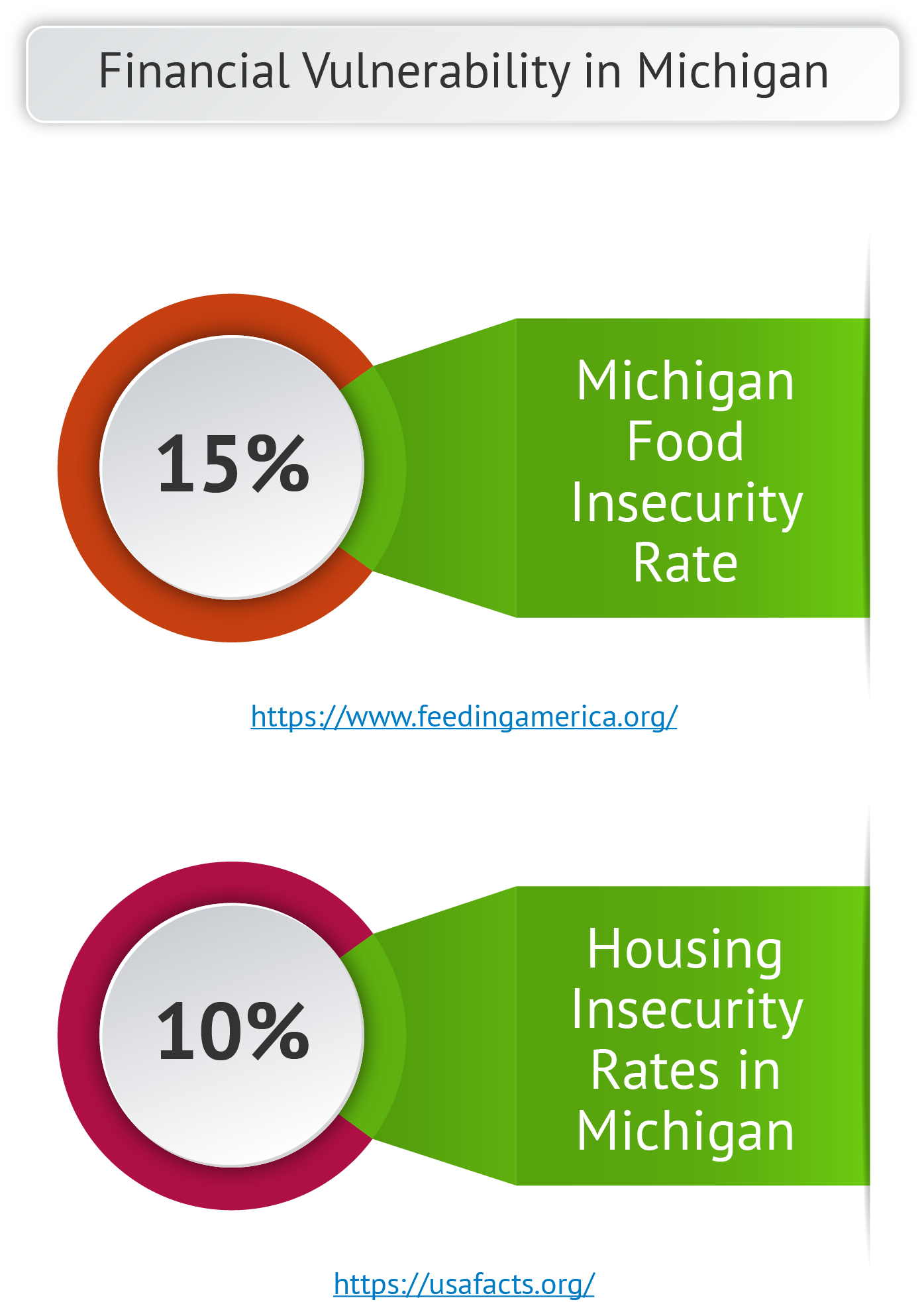
We characterize financial vulnerability using two primary metrics: food insecurity and housing insecurity. Feeding America is a nonprofit agency that tracks and reports annually on food insecurity across the U.S. According to its data, more than 1.5 million Michiganians are facing hunger currently – one in every six residents and 15% of the population. Out of those, an estimated 402,680 are children. Among Michigan families receiving SNAP (federal food assistance) benefits, 33.8% have children in the household.
In terms of housing insecurity, in 2024 the World Population Review reported that Michigan had an unsheltered population of 9,739, representing a homeless rate of 10%. The term “unsheltered” describes individuals who live in temporary or transitional housing or sleep in a place not intended for habitation (like an abandoned building). An estimated half a million people remain unsheltered across the U.S. today.
Statistics on Michiganians’ Financial Situations
Average Total Consumer Debt
By the end of 2025, total consumer debt in the U.S. had risen above $18.3 trillion, with an average American household debt balance of $104,755 according to an Experian study published in 2026. In Michigan, the average total consumer debt per user was somewhat lower than the nationwide figure – $76,414 – and had decreased by –1.3% from the 2024 estimate.
Debt by Individual Category
In conducting a categorical analysis, we find that Michiganians who carry student loan balances owed an average of $36,116, according to the World Population Review – adding up to a total of $51 billion in student loan debt across the whole state. A WalletHub report estimates the average credit card debt owed per user in Michigan at $7,016. And another study from the World Population Review says that, as of 2024, the average Michigan auto loan debt outstanding was $5,000.

Michigan Financial Literacy Legislation and Education Statistics
The National Education Association (NEA) issues regular reports that summarize state-level data characterizing number of schools, educators, and enrollments for each U.S. state, with the most recent report published in 2025. According to these data, during the 2023-2024 academic year Michigan had 822 public school districts in operation; with total student enrollment of 1,429,895. Those districts employed a total of 82,732 teachers that year, representing a pupil-to-teacher ratio of 17.3 to one.
Regarding financial literacy education policy, 2002 Act No. 111 (House Bill No. 5327) amended the Michigan Educational Code to mandate that “the department shall develop or adopt, and shall make available to schools, one or more model programs for youth financial education. A program under this section shall be designed to incorporate financial education throughout the curriculum for grades K to 12 and shall be based on the concept of achieving financial literacy… Each school district… is encouraged to adopt and implement the model financial education programs.”
Prior to 2022, Michigan Merit Curriculum required a one-half credit in Economics for high school graduation, also stating that “the ½-credit Economics requirement may be satisfied by completion of at least ½-course credit in Personal Economics that includes a Financial Literacy component… if that course covers the subject area content expectations for Economics.” In 2022 HB5190 was signed into law, mandating financial literacy as a curriculum requirement for high school graduation for the first time in state history.